
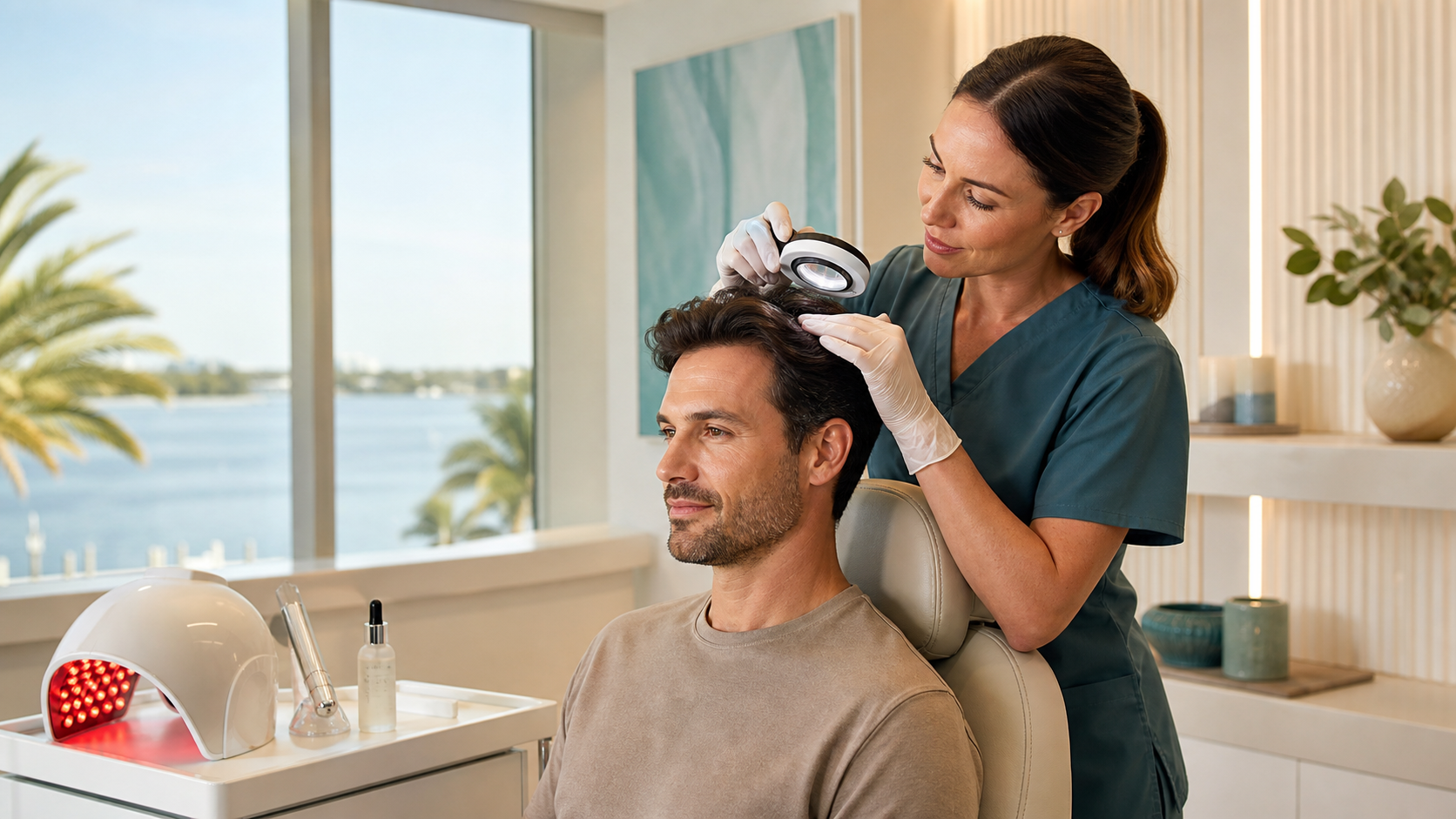
Harmony Med Spa's KeraFactor hair restoration approach combines an in-office growth-factor serum with scalp microneedling, red light therapy, and a KeraFactor home-care kit. The goal is a consistent scalp-care plan rather than a quick fix. Because hair thinning has many possible causes, candidacy and realistic expectations should be established during a professional consultation.
- Why combine several hair and scalp services?
- What is KeraFactor?
- How scalp microneedling fits into the plan
- What red light therapy contributes
- Why at-home care matters between visits
- What a KeraFactor visit may include
- How long does hair restoration take?
- Who may be a candidate?
- Questions to ask before starting
- Frequently Asked Questions
Hair growth occurs in cycles, and visible thinning can be influenced by genetics, hormones, illness, rapid weight change, medications, nutritional issues, scalp conditions, tight hairstyles, stress, and other factors. No single cosmetic service addresses every cause. Combining in-office and at-home steps can create a more organized routine, but it does not replace diagnosis when the pattern is sudden, patchy, painful, inflamed, or otherwise concerning.
The American Academy of Dermatology emphasizes that effective treatment begins with finding the cause. That is why a good consultation includes the timeline of shedding or thinning, family history, scalp examination, current products, recent health changes, and prior treatments. Harmony may be able to offer a supportive cosmetic plan, while some findings may warrant referral to a dermatologist or another medical professional.
KeraFactor is a hair-and-scalp product system built around topical formulations containing biomimetic growth factors and skin-supporting proteins. Harmony uses the professional serum within its in-office protocol and offers complementary home products. The words growth factor do not mean that every person will regrow hair, that inactive follicles can always be restored, or that the product treats every medical form of hair loss. Product-specific claims should remain consistent with current manufacturer labeling and the provider's assessment.
Scalp microneedling uses a professional device to create controlled microchannels in selected areas. In combined protocols, the procedure may be used to support topical application and a planned response in the treated scalp. Research on microneedling for hair loss is evolving; systematic reviews describe promising findings in some combined approaches while also noting differences in study quality, devices, depths, schedules, and companion treatments.
Professional screening matters. Active infection, open wounds, certain scalp disorders, bleeding risks, medication considerations, recent procedures, and a history of problematic healing may affect whether treatment is appropriate. At-home dermarolling is not the same as a controlled clinic protocol and can introduce irritation, contamination, injury, or inconsistent depth when performed improperly.
Low-level light or laser devices are used in some hair-loss plans. Reviews have found encouraging evidence for certain forms of pattern hair loss, but response varies and the evidence is not equally strong for every diagnosis. Device design, wavelength, dose, schedule, and consistency matter. Red light therapy should be presented as one possible component of a plan, not proof that a person will achieve a particular density or timeline.
Hair and scalp routines require consistency over months, not a burst of attention immediately after an appointment. The KeraFactor home kit gives patients a defined shampoo-and-conditioner routine to use according to instructions. Gentle handling, avoiding unnecessary traction and heat, following post-treatment guidance, and reporting irritation can be just as important as adding another product.
More supplements are not automatically better. The American Academy of Dermatology notes that excess amounts of some nutrients can worsen hair loss. Discuss vitamins, nutraceuticals, prescriptions, and topical hair products with an appropriate professional instead of stacking multiple products based on marketing claims.
- Review the pattern, duration, and possible contributors to thinning or shedding.
- Examine the scalp and discuss whether medical evaluation is advisable.
- Confirm whether scalp microneedling and red light therapy are appropriate.
- Perform the planned in-office protocol and apply the professional serum as directed.
- Explain short-term aftercare, the home kit, and what products to avoid.
- Set a realistic follow-up schedule and a method for comparing progress consistently.
Hair cycles are slow, so evaluating any plan usually requires patience and consistent photographs taken under similar lighting, angle, hair length, and styling. Short-term changes in shedding do not always predict the final response. The appropriate timeline depends on the cause of thinning, duration, treatment combination, adherence, and individual biology. Harmony should provide the schedule for its current protocol without guaranteeing a result by a particular date.
An adult with gradual thinning who wants a non-surgical, consistency-based scalp-care program may be interested in a consultation. Candidacy cannot be determined from a photo or keyword search alone. Sudden shedding, smooth bald patches, scarring, scaling, pain, pus, significant itching, eyebrow loss, systemic symptoms, or thinning after a major health change deserve proper evaluation. Earlier assessment can be valuable because some causes are easier to address before loss progresses.
- What type of hair concern does the provider believe this plan may support?
- What evidence and limitations apply to each component?
- How many in-office visits are proposed, and what is included?
- What should be used or avoided at home?
- How will progress be photographed and reviewed?
- When would the provider recommend dermatology, laboratory testing, or another treatment path?
1. What is KeraFactor hair restoration?
At Harmony, it is a combined hair-and-scalp plan using professional KeraFactor serum, scalp microneedling, red light therapy, and complementary home care. The exact recommendation depends on consultation and candidacy.
2. Does KeraFactor work for every type of hair loss?
No treatment works for every cause. Hair loss may be genetic, hormonal, nutritional, inflammatory, medication related, stress related, or connected to another condition. Some patterns require medical diagnosis or a different treatment.
3. What does scalp microneedling feel like?
Sensation varies with the device, treatment area, depth, and individual sensitivity. Ask Harmony how the scalp is prepared, what discomfort to expect, and what post-treatment tenderness or redness is considered typical.
4. How does red light therapy fit into hair restoration?
Low-level light therapy is used as a non-surgical component in some plans. Evidence is most encouraging for certain pattern hair-loss populations, but response varies and repeated sessions may be needed.
5. When might someone notice a change?
Hair growth cycles take time. The appropriate review period depends on the cause, plan, adherence, and individual response. Use standardized progress photos and the provider's schedule rather than expecting an immediate change.
6. Is the home-care kit optional?
Harmony offers home care as part of the combined approach. Ask whether it is included or purchased separately, how long it should be used, and whether any of your current scalp products should be paused.
If you are exploring KeraFactor hair restoration in Sarasota, schedule a consultation at Harmony Med Spa. Bring a list of medications, supplements, hair products, prior treatments, and recent health changes so the conversation can begin with the likely cause and a realistic plan.
Schedule a hair consultation with Harmony Med Spa in Sarasota.