
The skincare shelf can become crowded long before the skin improves. One product promises brightness, another texture, another pores, and a social-media routine somehow needs nine steps morning and night. Professional guidance is most useful when it subtracts confusion. At Harmony Med Spa in Sarasota, medical-grade skincare is part of the broader skin menu, but the phrase itself should not replace a clear explanation of ingredients, evidence, tolerance, cost, and purpose. A practical routine usually begins with three anchors: gentle cleansing, appropriate moisture, and daily sun protection. Then one targeted product can be added for the concern that matters most. Consistency and tolerability generally beat a cabinet full of products that irritate the skin or are used only occasionally.
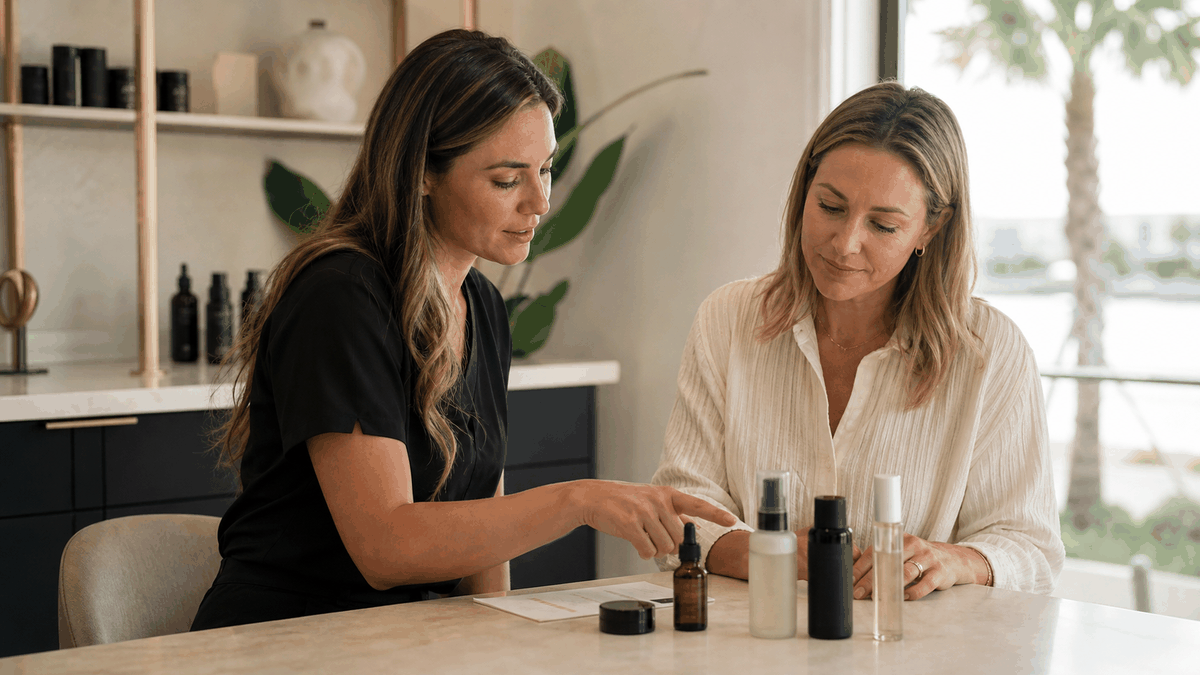
- What does medical-grade skincare actually mean?
- The three-part foundation
- Choose one target before adding an active
- A simple order for morning and evening
- Skincare before and after aesthetic treatments
- Adjust for Sarasota heat, humidity, and outdoor life
- How to shop without being oversold
- Frequently Asked Questions
Medical-grade is a marketplace term, not a separate legal category defined by the U.S. Food and Drug Administration. The FDA also notes that cosmeceutical has no meaning under federal law. A product is regulated according to what it is and the claims it makes: a cosmetic is intended to cleanse or beautify, while a product intended to treat disease or affect the body's structure or function may be a drug. This does not mean professionally sold skincare has no value. It means the label alone does not prove superiority. Value may come from formulation, packaging, stability, published evidence for an ingredient, professional selection, and follow-up. Ask what an item is meant to do, how to use it, what irritation to expect, and how its price compares with reasonable alternatives.
First, use a gentle cleanser that removes sunscreen, makeup, sweat, and daily residue without leaving the skin painfully tight. Second, use a moisturizer suited to how dry, oily, acne-prone, or sensitive your skin feels; barrier support is not only for dry skin. Third, protect exposed skin every morning with broad-spectrum, water-resistant SPF 30 or higher and reapply according to the label and your activities. The American Academy of Dermatology emphasizes that an effective routine does not need to be expensive and that using too many products can irritate the skin. In Sarasota, sunscreen habits matter year-round. Shade, hats, protective clothing, and thoughtful timing complement sunscreen, especially around procedures that increase sensitivity to the sun.
Write down the one concern you most want to improve: acne breakouts, uneven tone, fine lines, rough texture, dryness, redness, or maintenance around an aesthetic treatment. Different concerns may call for ingredients such as a retinoid, vitamin C, niacinamide, azelaic acid, salicylic acid, benzoyl peroxide, or another clinician-recommended option, but combining several immediately makes reactions difficult to interpret. Introduce one new active at a time, use it at the frequency advised, and give the skin time to show whether it tolerates the product. Patch testing can help identify irritation or allergy. Prescription products and diagnosed conditions require clinician direction. If a product burns, swells, blisters, or causes a persistent rash, stop experimenting and seek advice rather than covering the reaction with more actives.
A morning routine can be as short as gentle cleanse or rinse, a targeted product if recommended, moisturizer when needed, and sunscreen. An evening routine can be cleanser, the selected treatment product, and moisturizer. Apply medication or treatment products as directed, then moisturizer or sunscreen. The exact order can change with the vehicle and prescription, so follow the label and your clinician's instructions. More layers do not necessarily create more benefit, and rubbing several potent products together can increase irritation. Keep the routine visible and easy to repeat. If you cannot explain the job of a bottle in one sentence, pause it until the plan is clarified. Skincare should be a system you can maintain on an ordinary Tuesday, not a performance reserved for a perfect week.
Aesthetic procedures change the rules temporarily. Retinoids, exfoliating acids, scrubs, benzoyl peroxide, depilatories, and other active products may need to be paused before or after a peel, laser treatment, microneedling, waxing, or a device-based facial. The correct window depends on the procedure, the product, and the condition of your skin. Do not copy a generic timeline when your treating provider has given different instructions. After treatment, a bland cleanser, moisturizer, and sunscreen may be all that is appropriate until the barrier recovers. Avoid testing a new product during recovery. Bring your full routine to the consultation, including prescriptions, supplements, home devices, and products used only weekly. A photo of the labels is often easier than trying to remember ingredient names.
A routine that feels comfortable in a dry winter climate may feel heavy during a humid Sarasota summer. Texture matters for adherence: a lighter moisturizer or fluid sunscreen may be easier for some people, while air-conditioning, swimming, wind, and active treatments can still create dryness. Sweat and water also affect sunscreen reapplication. Choose products you will actually use during beach days, golf, outdoor workouts, commuting, and travel. Acne-prone skin may prefer non-comedogenic options, but that label does not guarantee every individual will tolerate a product. Seasonal adjustment should be measured rather than dramatic. Change one variable, watch the skin, and keep the protective basics steady. The goal is not to make skin feel stripped in humidity; it is to support it without unnecessary heaviness.
Harmony's team can use a skin consultation to help sort what to keep, what to pause, and what one addition may have the clearest purpose. Bring everything, even products purchased elsewhere. Good guidance should not require replacing an entire routine if several items are already working. It should also acknowledge when a dermatologist is the better next step for persistent acne, eczema, suspicious lesions, infection, or another medical concern. The finished plan may look almost boring: cleanser, moisturizer, sunscreen, one active, and a date to reassess. That is often a strength. A routine earns its place by being understandable, tolerable, affordable enough to continue, and connected to the outcome you actually care about.
1. Is medical-grade skincare regulated differently from drugstore skincare?
Medical-grade is not a separate FDA category. Products are regulated based on their intended use and claims. Evaluate ingredients, evidence, formulation, guidance, and tolerance rather than the phrase alone.
2. Do expensive skincare products work better?
Not necessarily. The AAD notes that effective skincare does not have to be expensive. A suitable formulation used consistently may matter more than price or prestige.
3. What are the most important skincare steps?
For many adults, a gentle cleanser, appropriate moisturizer, and broad-spectrum SPF 30 or higher form the foundation. A targeted product can then be selected for a specific concern.
4. How many active products should I start at once?
Usually one at a time is easier to tolerate and assess. Follow professional or label instructions, patch test when appropriate, and avoid combining potent actives without guidance.
5. Should I stop retinol before a facial or laser treatment?
Possibly, but the timing depends on the product and procedure. Ask the treating clinic for exact pre- and post-care instructions instead of using a universal timeline.
6. When should I see a dermatologist?
Seek medical evaluation for persistent or severe acne, eczema, infection, a changing or suspicious spot, a significant reaction, or any condition that needs diagnosis and treatment.
Review your skincare routine with Harmony Med Spa in Sarasota.