
These three get used interchangeably and they shouldn't be. They're staffed differently, regulated differently, and suited to genuinely different things. Picking the wrong one usually means wasted money, or a treatment that was never going to address what was bothering you.
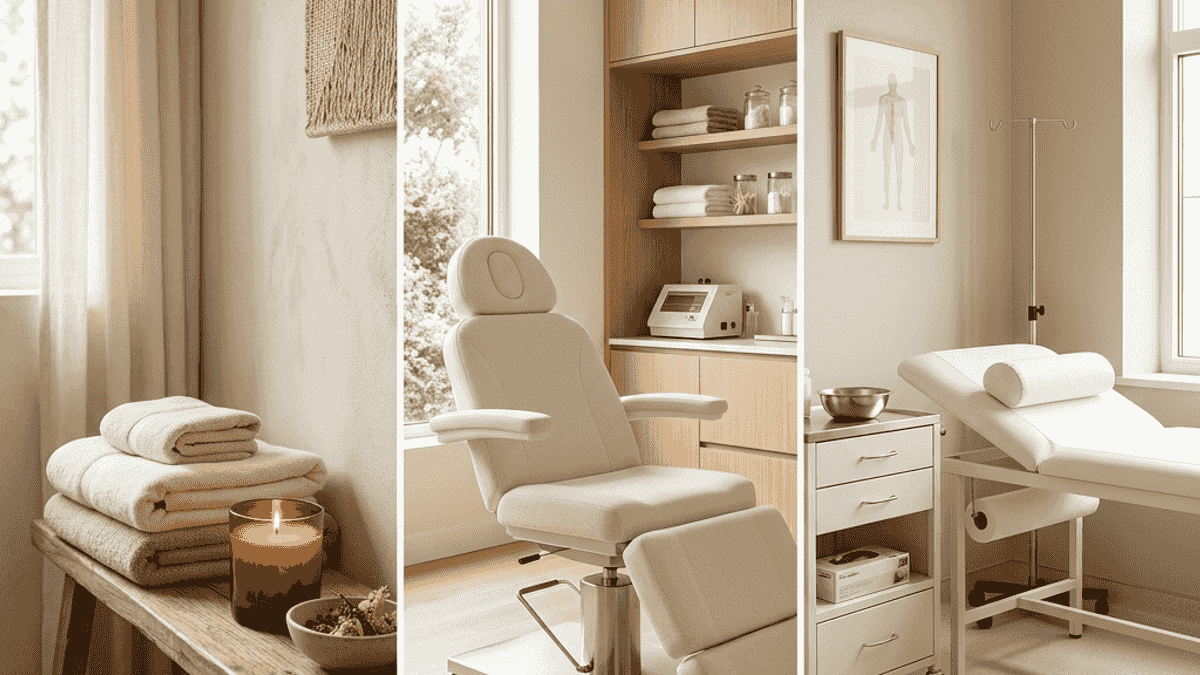
- Day spa
- Med spa
- Dermatologist
- Working out which you need
- When it's genuinely unclear
- Questions worth asking any clinic
- Frequently Asked Questions
A day spa is a relaxation and beauty setting. Massage, standard facials, body treatments, nails. Staff are typically licensed estheticians, massage therapists, and nail technicians. Day spas work on the surface of the skin and on how you feel. There's no medical provider on site and no prescribing. If you want to relax, or want a facial that leaves your skin feeling good, this is the right place and you don't need anything more clinical.
A medical spa combines aesthetic treatment with medical oversight. There's a physician or nurse practitioner involved, which allows treatments a day spa can't offer — injectables, medical-grade lasers, prescription skincare, and medically supervised wellness programs. The setting is usually comfortable rather than clinical, but the treatments are medical. That distinction is the entire point: you get results that require medical training, without the atmosphere of a hospital. At Harmony Med Spa, Jessica Simone, AGNP-C, is a board-certified nurse practitioner, and treatments are provided under that oversight.
A dermatologist is a physician specializing in diseases of the skin. Suspicious moles, persistent rashes, severe or cystic acne, psoriasis, eczema, skin cancer screening — these are dermatology, not aesthetics. Many dermatologists also offer cosmetic treatments, and many med spas handle cosmetic concerns well. The dividing line is disease. If something might be a medical skin condition rather than a cosmetic concern, see a dermatologist first.
The dividing line is disease. Cosmetic concern, med spa. Something that might be a medical condition, dermatologist — first.
- You want to relax, or want a facial and a massage → day spa
- You want smoother skin texture, softer lines, or help with pigmentation → med spa
- You have a mole that's changed, a rash that won't clear, or severe acne → dermatologist
- You want injectables or medical-grade laser treatment → med spa
- You want medically supervised weight management or hormone support → med spa or physician
- You need a skin cancer screening → dermatologist

Plenty of concerns sit in the middle. Acne can be cosmetic or medical depending on severity. Pigmentation can be sun damage or something that needs evaluating. Hair loss can be hormonal, genetic, or a symptom of something else. When it's unclear, a consultation with a medical provider is the efficient move — a med spa with a nurse practitioner or physician can assess and tell you whether you're in the right place. If you're not, we'll say so and point you somewhere appropriate. That's a better outcome than paying for a treatment that was never going to help.
- Who will actually be performing my treatment, and what are their qualifications?
- Is there a medical provider on site?
- Will someone review my medical history before treatment?
- What happens if I have a reaction or a complication?
The answers tell you quickly which of the three you're actually standing in, regardless of what's on the sign.
1. Is a med spa the same as a medical spa?
Yes — the same thing, used interchangeably. Both should mean medical oversight is in place. It's worth confirming rather than assuming, since the terms aren't uniformly regulated everywhere.
2. Does a med spa need a doctor on site?
Requirements vary by state and by treatment. In practice, look for a physician or nurse practitioner involved in care rather than treatments delivered by unsupervised staff. Ask directly — a reputable clinic will answer without hesitation.
3. Can a med spa treat acne?
Cosmetic acne concerns, often yes. Severe or cystic acne is usually better handled by a dermatologist, and a good med spa will tell you that rather than treat you anyway.
4. Is a med spa more expensive than a day spa?
Generally yes, because you're paying for medical training and medical-grade equipment. Whether it's better value depends entirely on what you're trying to achieve — for relaxation, a day spa is the better buy.
5. Can I go to a med spa for a massage?
Some offer it, many don't. Harmony Med Spa focuses on aesthetic and wellness treatments rather than massage and body relaxation services. For massage, a day spa is the right place.
Talk to our medical team with Harmony Med Spa in Sarasota.